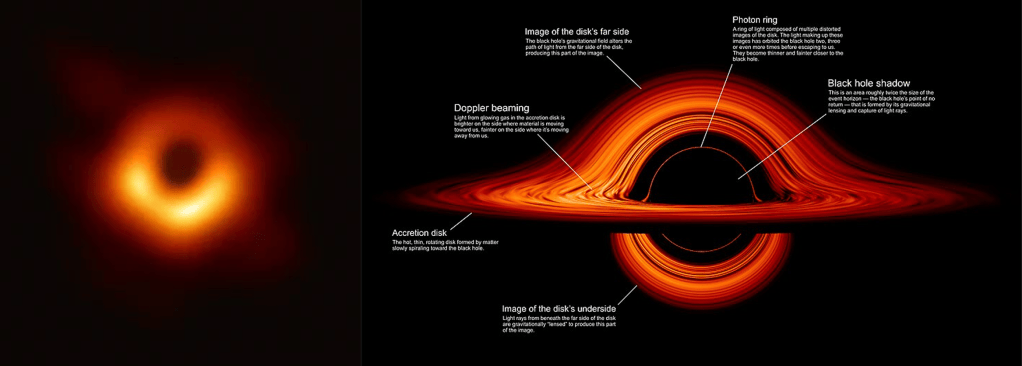
What happens to a person who falls into a black hole? No human has ever made that journey, and anyone who have could never return to tell the story. Yet Einstein’s theory of general relativity predicts what lies within a blackhole: it’s called a singularity [1].
Singularity refers to a point at which normal rules stop working because values become infinite or completely unpredictable. For example, dividing a number by zero returns “undefined”. This is a construct unknown and undefined – a singularity. It’s the same idea in outer space, a simple thought experiment can help us better understand this concept!
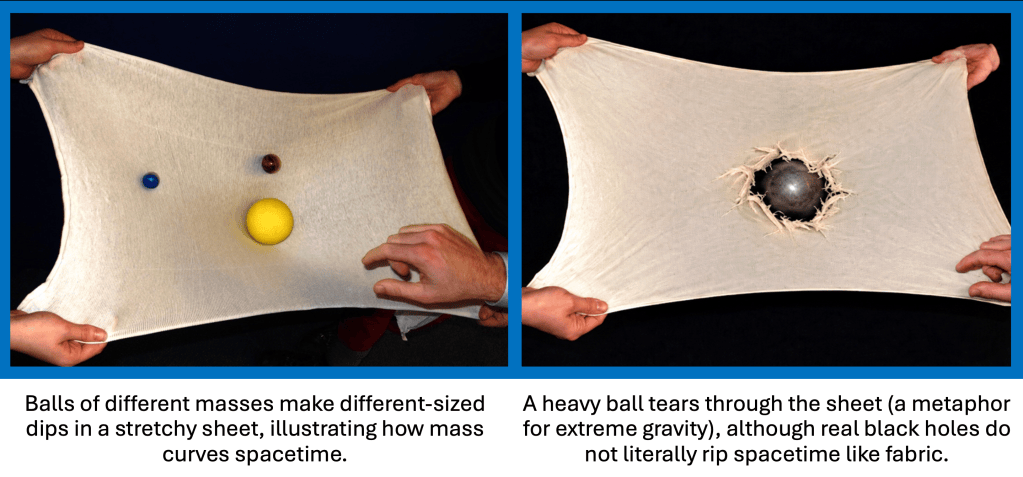
Imagine outer space is like a big, stretchy blanket pulled tight. A light ping-pong ball would make only a tiny dip. A heavier golf ball would make a bigger dip. This is how mass (e.g., planets and stars) curves spacetime. In the case of a blackhole, an object reaches gravity so intense that spacetime itself collapses. Like a ball the size of a golf ball, but as heavy as an elephant would completely rip apart the blanket!
In our imaginary experiment, the ball would fall through the hole. But what happens to a person who is sucked into a black hole in outer space? Where do they fall?
Einstein’s theory predicts that they would reach a singularity: an extreme endpoint that is unexplainable. What really happens there remains an open question. What is even more fascinating is that general relativity is our most successful description of physical reality. Yet following its predictions into a black hole leads us to an edge. The description breaks down. In a sense, the theory predicts its own limits, suggesting that it may be incomplete.
It gets even crazier! Because black holes eventually die (they evaporate!) [2]. What ultimately happens to the information carried by everything that fell inside remains one of physics’ deepest unresolved questions.
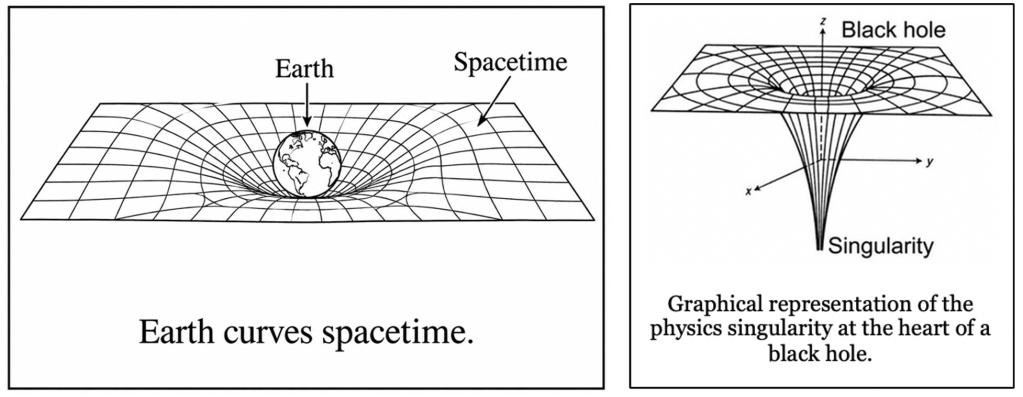
While in textbooks, singularity is depicted as a collapse, stretching down, it simultaneously transcends the laws of physics. The idea of singularity is also echoed in literature, particularly in transhumanism: where a transhuman is an “improved” version of the average human through pharmacological, cybernetic and genetic means. Indeed, we have our own version of singularity, referred to as human or technological singularity. As the neuroscientist Dr. Robert E. Hampson explains [3]:
“To futurists like Kurzweil, Vinge or Good, the human singularity is a point at which change is so rapid, faster than the ability to comprehend that there even is change, that it might as well be a wall separating the merely “human” Homo sapiens sapiens from our replacement H. sap. superior.”
So when our evolution as a species reaches its “max”, we may transcend our limits to the degree that we are no longer able to predict what we may evolve into next. We become unpredictable, undefinable. Of course, this is just in theory…
Transhumanism is a popular concept in fiction, and some examples of include: Ghost in the Shell by Masamune Shirow, Altered Carbon by Richard K. Morgan, Frankenstein by Mary Shelley, and Flowers for Algernon by Daniel Keyes.

So, do you think humanity could reach a technological singularity? Could we transform so profoundly that we transcend not the laws of physics, but the limits of what we understand it means to be human?
Leave a comment below!


Leave a Reply